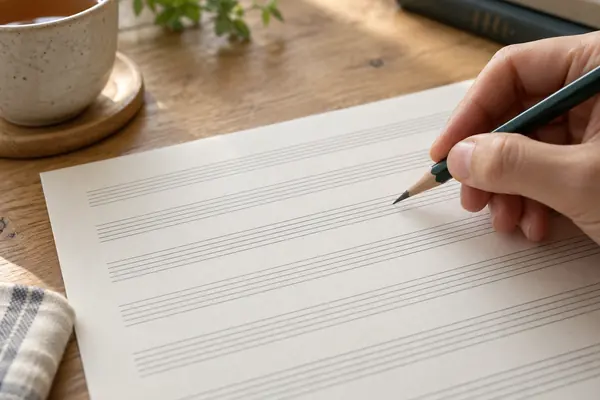
THE STAVE
Five lines and four spaces
A stave is usually five horizontal lines. Each line and space is a different pitch, and higher notes sit higher. Ledger lines extend it above or below.
Where it came from doodlenotewiki

UP = HIGHERleft to right = time
Height on the stave shows pitch, and the shape of each note shows how long it lasts. Learn what the clef, the note shapes and the two numbers at the start tell you, and a page of music starts to make sense.
Updated
THE SHORT ANSWER
Western notation puts pitch on the vertical axis
and time on the horizontal, read like a book.
THE STAVE
A stave is usually five horizontal lines. Each line and space is a different pitch, and higher notes sit higher. Ledger lines extend it above or below.
Where it came fromTHE CLEF
The clef at the start fixes which note each line means. The treble clef puts the G above middle C on the second line; the bass clef covers lower notes.
Remember the linesNOTE VALUES
A semibreve, minim, crotchet and quaver each last half as long as the one before. Rests show silences of the same lengths.
Try the note checkA QUICK NOTE CHECK
Pick a note to see its British and American names and how many crotchet beats it lasts. The bar shows how long the note is held.
Unmodified note values are fractions of a semibreve: one, a half, a quarter and so on. Counted here in crotchet beats, as in 4/4 time.
TWO NUMBERS WORTH KNOWING
One number from the history of the stave,
one from how music is written today.
5 lines
Lines on the modern stave
Guido d'Arezzo (990–1050) is credited with modern staff lines, using a four-line staff still seen in Gregorian chant books. Five-line staves appeared in Italy in the 13th century.
THE STAVE · HISTORY
4 clefs
Clefs in regular use
Only treble, bass, alto and tenor clefs are used regularly in modern music, and treble and bass are by far the most common. The viola is the best-known user of the alto clef.
CLEFS · TODAY
History and clef usage from the Wikipedia articles on the staff and on clefs, which cite the Harvard Dictionary of Music and Grove Music Online.

FOUR STEPS TO READ A LINE
Western notation is read left to right and top to bottom, like a page of English. Check these four things before the first note.
Treble clef for higher parts such as flute or soprano, bass clef for lower ones such as trombone or bass voice.
The bottom number names the note being counted (4 is a crotchet, 8 a quaver). The top number says how many fit in each bar.
Use the clef's line and space names. Notes above or below the stave sit on short ledger lines.
Work out each note's length from its notehead, stem, flags and beams, and keep a steady count through each bar.
REMEMBERING THE LINES
The classic memory aids: on the treble clef the lines are E G B D F, 'Every Good Boy Does Fine', and the spaces spell F A C E. On the bass clef the lines are G B D F A, 'Good Boys Do Fine Always', and the spaces A C E G, 'All Cows Eat Grass'.
Piano music joins a treble and a bass stave with a brace, called the great stave in British English. Middle C sits between them on a short ledger line, and the upper stave is normally played with the right hand.
Questions
Both. British English usually says stave and American English staff. The plural is staves. A treble and bass stave joined by a brace for piano is a great stave, or grand staff in American English.
It fixes one line as a particular note, and every other line and space follows from it. The treble clef fixes the G above middle C on the second line, the bass clef fixes the F below middle C.
British names such as minim, crotchet and quaver go back at least to English Renaissance music. American names count fractions of a whole note: half note, quarter note, eighth note.
That is the time signature. The bottom number names the note value being counted (2 a minim, 4 a crotchet, 8 a quaver) and the top number says how many fit in each bar.
Short extra lines added above or below the stave for notes too high or too low to fit on its five lines. Middle C on a treble stave sits on the first ledger line below.
ABOUT THIS NAME
doodlenotewiki.com is part of the DoodleSale portfolio. It isn't in an auction right now, but you can ask about leasing it.